


 JOIN MY MAILING LIST
September, 17
2026
South India Photo Tour 2026 Report
Harry Fisch
When a painted figure twelve feet tall, crowned in fire and silver, fixes you with the gaze of a god, the camera stops feeling like a barrier and starts feeling like a privilege. That was the through-line of our March 2026 expedition across South India — ten days that moved from the roar of Mumbai’s streets to the absolute stillness of the Kerala backwaters, with two of India’s most extraordinary rituals in between.
MUMBAI
We began in Mumbai, where the city does half the work for you. An afternoon briefing, then straight out into the streets — vendors, commuters, the constant collision of colonial stone and glass towers, the light going amber over the chaos. It was the perfect warm-up: a day to recalibrate, to remember how to see, before the intensity of the south.
KANNUR
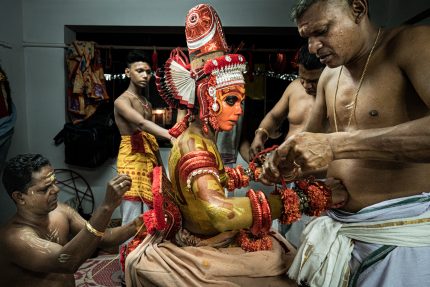
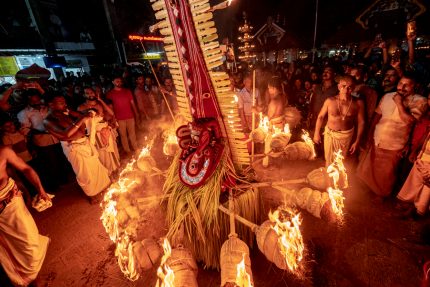
The next morning we flew to Kannur, and here the expedition found its heart. For two days and, more importantly, two nights, we photographed Theyyam — the several-thousand-year-old ritual in which a performer, the Kolam, is transformed through hours of painting and dressing into a living deity. The word itself comes from Deyvam, “god,” and aattam, “dance”: the dance of god.
Nothing quite prepares you for it. Faces painted in startling vermilion, headdresses towering into the dark, beads and cloth catching the firelight as the drums build toward something close to trance. The ceremonies ran late into the night, and our small group worked the fire and torchlight for hours — chasing the moment a man becomes a god, dodging the occasional fire-bearing deity charging through the crowd. As one of our travelers put it on a previous edition, the trick was getting the night action shots while avoiding being knocked flat by one of the burning “gods.”
We used the mornings the way they’re meant to be used: recovering, drifting down to the beach, wandering the nearby fishing villages, photographing the daytime rituals in softer light. Then back to the temple as the sun dropped, for another night of devotion and smoke.
COCHIN
We reached Cochin in the early evening and went straight out, just before sunset, to the Chinese fishing nets — those great cantilevered contraptions silhouetted against a sinking sun, fishermen hauling them in by hand. We’d hand-picked the spot, and it delivered. We came back at sunrise to work the same scene in the cool dawn light, then drifted into the fish market, the famously photogenic open-air laundry, and the colonial streets, with stops at the Paradesi Synagogue, the Dutch Palace, and the Vasco da Gama church.
The crown of our Cochin days, though, was the private Kathakali session. We rented the entire theater — not just the stage, but the makeup rooms, the dressing rooms, the whole quiet machinery behind the art. That access is everything. We photographed the hours of green-and-crimson makeup being layered on, the elaborate costumes being tied, the performers in their last moments of meditation before transformation. By the time the live Carnatic music began and the deliberate, story-telling gestures took over, we’d already documented the human side of it — the discipline and devotion that the polished stage performance usually hides.
THRISSUR
From Kannur we drove a few hours east to Thrissur for the Elephant Festival — and “photographic dream come true” is not an exaggeration. Caparisoned elephants, draped in dyed cloth and beads and crowned with golden nettipattam, paraded toward the temples carrying effigies of the deities, while drummers and dancers swirled at their feet in waves of sound and motion.
We gave the festival a full day: a handful of planned vantage points, but mostly we let it run wild — this is a day for spontaneous, reactive shooting, because the scene never holds still. Gold and silk under the tropical sun, the faces of mahouts and pilgrims, the sheer scale of the animals against the crowd. The following morning, before leaving the region, we visited Punnathur Kotta, the Guruvayur elephant camp — home to more than fifty temple elephants. Watching the gentle giants being bathed, fed and prepared, with the mahouts at close quarters, gave us the quieter, more intimate counterpoint to the festival’s spectacle.
BACKWATERS
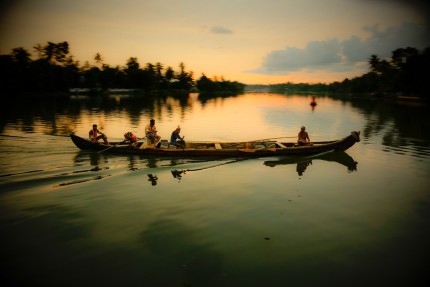
For the finale, the expedition exhaled. We drove to Alleppey and boarded our private houseboat — our own crew, our own cook turning out fresh Keralan meals as we cruised. We stopped at Muhamma to see the village market and the making of coir rope, then drifted on toward Pathiramanel to anchor for the night.
The backwaters are a labyrinth of lakes and canals where rural life simply flows past your lens: children leaping into the water, women washing clothes at the edge, fishermen up to their necks feeling for fish with their feet, rice barges gliding by, palms reflected in glassy green channels. After ten days of high-intensity festival shooting, the slow tempo was its own kind of gift — golden-hour reflections, intimate portraits, the gentle textures of daily life. We woke to mist on the canals, made our last frames, and cruised slowly back toward Cochin.
CODA
This was a tour built on access more than itinerary — a private theater, a private boat, two full nights at the Theyyam, an unhurried day inside the Elephant Festival. We stayed a small group throughout, which is exactly why it worked: enough room to move, to wait for the moment, to go deeper than a fleeting tourist glance. Mumbai gave us energy, Kannur gave us the divine, Thrissur gave us spectacle, Cochin gave us craft, and the backwaters gave us stillness. It’s a rare arc — and for the photographers who came home with it on their cards, an unforgettable one.
