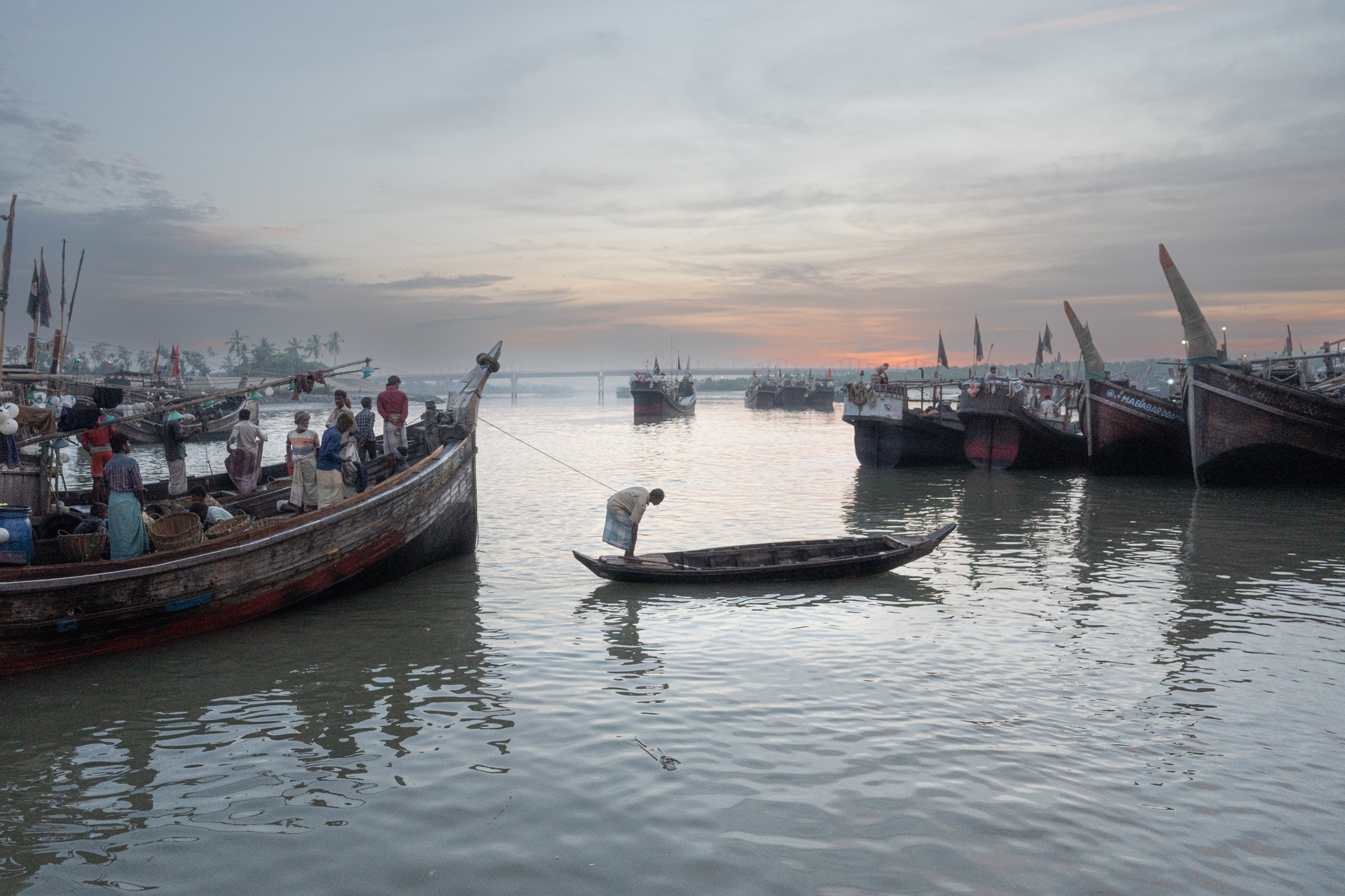
Day 01 – Arrival in Dhaka
We land at Hazrat Shahjalal International Airport in Dhaka. After clearing immigration and customs, our representative meets us outside the arrival terminal's exit gate and transfers us to the hotel to check in and freshen up. The evening brings an orientation briefing — a chance to align on routines, light, and the days ahead — followed by a welcome dinner. It is a gentle first contact with the city, time to ready cameras and settle into the rhythm of the journey.
Photographic Opportunities: Arrival is light on shooting, but the airport approach, first street scenes from the transfer, and the welcome dinner offer early frames: faces of the team, the texture of the city at dusk, and quiet hotel-side portraits as the group gathers.
Accommodation: Super Deluxe Room at Grand Palace Hotel, Dhaka (4-star local chain)
Meals: Buffet dinner at the hotel
Day 02 – Fabric Dyeing Fields & Urban Slum
We leave early, around 0600–0630 hrs, driving 35 km to Araihazar to photograph the vibrant textile-drying process, where dyed cloths are spread across open grounds to dry in broad sheets of color.
From there we may visit the Jamdani weaving village at Rupshi, Demra, a short drive away, where handloom weavers produce the region's celebrated fine muslin. In the afternoon we turn to documentary work in one of Dhaka's densely populated informal urban communities, a slum area where daily life proceeds at close quarters. We stay alert to our belongings here, as the area is not entirely safe and pickpockets move among visitors. We overnight in Dhaka.
Photographic Opportunities: Fields of drying cloth in saturated color, dyers turning and lifting fabric, the rhythmic motion of Jamdani handlooms, and weavers' hands at work. In the settlement: candid street portraits, doorway scenes, children at play, and the textures of close-packed community life — made with care and consent.
Accommodation: Grand Palace Hotel, Dhaka
Meals: B/L/D
Day 03 – Brick Kiln Factories
Today we visit two separate traditional brick kiln factories in Savar, 50–60 km from the capital, witnessing workers use time-honored methods to shape, transport, and fire bricks in massive ovens. The scale is industrial yet entirely human-powered: figures moving stacks across smoking yards, the geometry of drying bricks, and the haze of the kilns. We may also visit the river jetty to photograph coal loading, if it is in operation, where laborers carry heavy baskets along the waterline. We overnight in Dhaka.
Photographic Opportunities: Workers shaping and stacking bricks, lines of fired and unfired blocks in repeating pattern, the smoke and chimneys of the kilns, and silhouettes against the ovens. At the jetty: porters bearing coal baskets, dust-streaked portraits, and the play of light and labor along the river's edge.
Accommodation: Grand Palace Hotel, Dhaka
Meals:B/L/D
Day 04 – River Labour & Silver Workshops
We discover Old Town — the spice market, the fruit market, the Sadarghat waterfront, the Buriganga River, Tanti Bazar, and Shakhari Bazar. The busy river jetty teems with the loading and selling of goods; bakers turn out Bakarkhani, old Dhaka's famous flatbread, while people gossip on thin stools, dipping the bread into tea. Live kitchen scenes unfold, Shankhari artisans craft bangles from shell — the trade that gives Shakhari Bazar its name — and silver craftsmen shape jewelry. There is no shortage of subjects on which to focus our lenses, from commerce to craft to candid street life. We overnight in Dhaka.
Photographic Opportunities: Waterfront porters and cargo at Sadarghat, vendors in the spice and fruit markets, bakers at the Bakarkhani ovens, tea-drinkers on low stools, shell-bangle makers mid-task, and silversmiths at the bench. Tight portraits and busy environmental frames reward patience in the lanes of Tanti and Shakhari Bazar.
Accommodation: Grand Palace Hotel, Dhaka
Meals: Dinner at a local Chinese/continental buffet restaurant
Day 05 – Poultry Market & Ship-Breaking Yard
Early, around 0530–0600 hrs, we visit a wholesale raw market in the Mirpur area to photograph the loading and unloading of goods and the selling of poultry, fish, and vegetables — a chaotic, vivid morning at one of Dhaka's largest markets. We then drive to Keraniganj to see the ship-repairing yard along the Buriganga River, where vessels are dismantled by hand against a raw industrial backdrop.
Sparks, steel, and the bodies of workers define the scene. We may also visit a nearby aluminum factory, adding another layer of manual industry to the day. We overnight in Dhaka.
Photographic Opportunities: Pre-dawn market chaos: porters under load, fishmongers, poultry cages, and vegetable stacks lit by bare bulbs. At Keraniganj: workers cutting and hauling steel, sparks against shadow, hulls under repair, and grease-marked portraits. The aluminum factory offers heat, glow, and the focused gestures of skilled hands.
Accommodation: Grand Palace Hotel, Dhaka
Meals: B/L/D
Day 06 – Fly to Cox's Bazar
[ref flight schedule: BS-141 DAC CXB 0720 0825 or BS-143 DAC CXB 0830 0935]
After an early or take-away breakfast, we transfer to the domestic airport and fly to Cox's Bazar. On arrival we visit the Aggameda Khyang, raised on round timber columns — a large Buddhist monastery revered by some 400,000 Buddhists of Cox's Bazar and the Chittagong hill tracts, holding a prayer hall, an assembly hall, bronze Buddha images of mostly Burmese origin, and old manuscripts.
We continue to Himchari National Park just south of town, with tropical rainforest, grassland, and seasonal waterfalls that spill toward the beach in the rains. We then drive to Inani Beach, an 18 km calm, quiet coral shore.
Photographic Opportunities: Monks, devotees, and the timber halls and bronze images of Aggameda Khyang; forest light and cascades at Himchari; and the long, quiet curve of Inani's coral beach. Coastal portraits, fishing figures on the sand, and wide land-and-sea compositions in soft afternoon light.
Accommodation: Sea View Room at Sea Palace Hotel, Cox's Bazar (or similar 4-star standard)
Meals:B/L/D
Day 07 – Dry Fish Market & Boat Landing — Return to Dhaka
[ref flight schedule: BS-158 CXB DAC 1835 1940]
In the morning we drive to Nazirartek to visit Bangladesh's largest dry-fish processing zone, where thousands of fish hang in geometric rows on bamboo racks under open sky. We then move to the boat-landing site to watch fishermen unload the day's catch from the sea, a scene of weight, water, and coordinated effort. In the evening we fly back to Dhaka, dine at a restaurant, and transfer to the hotel for the night.
Photographic Opportunities: Endless bamboo racks of drying fish in repeating pattern, workers moving among the rows, and the silver shimmer of the catch. At the landing: fishermen hauling nets and baskets, boats nosing ashore, and salt-worn portraits against sea light — strong graphic frames and candid human moments.
Accommodation: Super Deluxe Room at Grand Palace Hotel, Dhaka
Meals: B/L/D
Day 08 – Inspirational School & Slum Community
This morning we visit a remarkable school where special-needs children learn singing, dancing, painting, crafting, cooking, dyeing, and computer skills — work that helps them grow self-reliant, and an inspiring, moving portrait opportunity. Alternatively, we may visit a madrassa where children from poor families learn Arabic at low cost, or orphans study for free; their day begins very early, around 0300–0330 hrs, and runs late with short breaks for meals and rest.
In the afternoon we document another slum area near the train line, continuing our community photography along the tracks. We overnight in Dhaka.
Photographic Opportunities: Expressive classroom portraits — children singing, painting, and crafting — and quiet moments of concentration; or madrassa pupils at dawn study in low light. Trackside: candid community life, children near the rails, doorway scenes, and environmental portraits made with patience and consent.
Accommodation: Grand Palace Hotel, Dhaka
Meals: Dinner at a local Chinese/continental buffet restaurant
Day 09 – Rice Processing Region
Early, around 0600 hrs, we drive to Brahmanbaria District — roughly 110 km and about three hours from Dhaka — to see the rice-processing factories. We photograph how workers collect rice, dry it across large fields, and store it, following the grain through each stage of labor. The wide drying yards, figures raking and turning rice, and the play of dust and light make for strong documentary and pattern-driven frames. We return to Dhaka in the evening and overnight.
Photographic Opportunities: Vast drying fields with workers raking rice into shifting patterns, women carrying and spreading grain, steam and dust in low light, and tight portraits of laborers mid-task. Repeating lines, warm tones, and human scale against the open yards reward both wide and close compositions.
Accommodation: Grand Palace Hotel, Dhaka
Meals:B/L/D
Day 10 – Rakher Upobash Festival
In the afternoon we drive 30 km to Barodi for the Rakher Upobash festival at the Sri Sri Loknath Brahmachari Ashram. Known as Karthik Vrat, Rakher Upabas, Gonsair Upabas, and Ghrit Pradip Prajjalan, it stands as a testament to Bengal's devotion and cultural richness, fostering a deep bond between devotee and divine. Thousands converge from far and wide for the sacred rituals, the candle flames a beacon of hope through the journey of life. Held each Saturday and Tuesday of the last fifteen days of Kartik, it gathers worshippers before the temple at dusk; bathed in candlelight, they immerse themselves in prayer for blessings and solace as chants fill the air.
We return to Dhaka late and overnight.
Photographic Opportunities: Rows of devotees before the temple in pooled candlelight, faces lit from below, hands cupping flames, and offerings of ghee lamps. Dusk-to-dark low-light portraiture, chanting crowds, ritual gestures, and the warm glow of massed candles against deepening shadow — among the trip's richest atmospheric frames.
Accommodation: Grand Palace Hotel, Dhaka
Meals: Dinner at a local Chinese/continental buffet restaurant
Day 11 – Departure
After breakfast and hotel checkout, we transfer to Hazrat Shahjalal International Airport (DAC), Dhaka — international terminal — for individual onward flights. Here our services end, cameras full of the labor, faith, and faces of Bangladesh.
Photographic Opportunities: A few final frames remain — packing the gear, last group portraits in the hotel lobby, and parting street scenes on the transfer to the airport as the journey closes.
Accommodation: None (departure day)
Meals: Breakfast at the hotel