Day 1 – 10th July 2027 – Arrival in Delhi
Our journey opens in Delhi. On arrival at Indira Gandhi International Airport, our representative receives us and accompanies us to the pre-booked hotel at Aerocity, located close to the terminal for the early flight onward to Leh.
The evening is unstructured — time to rest, organise camera bags, and prepare for the high-altitude days ahead.
Photographic Opportunities: Arrival reportage at the airport, low-light interior frames in the hotel and around Aerocity, and quiet preparation portraits. A useful evening to test gear, recalibrate exposure routines, and gather details of the modern Indian capital before we ascend into Ladakh's altitude and silence.
Accommodation: Pride Plaza Hotel Aerocity, New Delhi
Meals: None
Day 2 – 11th July 2027 – Delhi to Leh, Acclimatisation
We take an early-morning flight from Delhi to Leh, climbing rapidly from the plains into the trans-Himalayan plateau. On arrival, we transfer to our pre-booked hotel by mid-afternoon and check in.
The remainder of the day is deliberately quiet. The first day at altitude is significant for acclimatisation — we rest, drink water regularly, and remain at the hotel rather than venturing out. Acclimatising properly here is the foundation for every active day to follow.
Photographic Opportunities: Aerial views of the Himalayas from the descending aircraft, rooftop and balcony images of Leh's brown-and-white houses framed against arid mountains, and the first cultural details of the town — prayer wheels, distant monastery silhouettes, and the warm internal palette of our Ladakhi hotel for early environmental portraits.
Accommodation: Charmwood Hotel, Leh
Meals: Breakfast/Lunch /Dinner
Day 3 – 12th July 2027 – Thiksey Dawn Prayer & Ladakhi Concept Shoot
We leave the hotel before dawn, arriving at Thiksey at five in the morning to witness and photograph the early prayer ritual. Inside the lamp-lit hall, robed monks chant, blow long horns, and pour butter tea, the air dense with juniper smoke. Thiksey is a twelve-tiered hilltop complex resembling Lhasa's Potala in miniature.
We return to the hotel for rest. At sunset, we arrange a Ladakhi women tribal concept shoot near Leh — staged portraits in traditional dress, jewellery, and headdresses, working with the descending light against the surrounding desert ranges.
Photographic Opportunities: Interior prayer-hall images with chanting monks, butter-lamp glow, ritual instruments, and pilgrim hands at offerings. At sunset, controlled portrait work — embroidered gowns, perak headdresses, turquoise ornaments, weathered hands, and considered eye contact with subjects against Ladakh's dusty pastel ranges.
Accommodation: Charmwood Hotel, Leh
Meals: Breakfast/Lunch /Dinner
Day 4 – 13th July 2027 – Hemis Festival & Shanti Stupa
After an early breakfast, we drive to Hemis Monastery, the most famous gompa of Ladakh, today fully decorated for the Hemis Festival. This is one of the most spectacular and colourful celebrations of the Ladakhi calendar, drawing monks, villagers, and pilgrims into its courtyards.
We spend almost the entire day shooting the festival — masked Cham dances, elaborate brocade robes, ritual percussion, and the densely packed crowd of devotees in their finest attire.
By evening we drive to Shanti Stupa above Leh for the sunset shoot, the white dome catching the last warm light as the valley falls into shadow. Overnight stay at Leh.
Photographic Opportunities: Masked Cham dancers in full motion, monk portraits backstage, festival crowd reportage, pilgrim and elder portraits in ceremonial dress, ritual objects, and prayer-flag detail. At Shanti Stupa: golden-hour architectural studies, silhouettes against the Leh valley, and ambient twilight skies behind the white dome.
Accommodation: Charmwood Hotel, Leh
Meals: Breakfast/Lunch /Dinner
Day 5 – 14th July 2027 – Drive to Dah Village & Brokpa Portraits
After an early breakfast, we begin our journey of 200 km / 5 hours' drive to the beautiful Dah village in the Aryan Valley for a Brokpa tribal portrait shoot. The Brokpas — often known as the Ladakhi Aryans — carry a heritage distinct from the rest of Ladakh, with significant differences in traditions, customs, and attire, and a culture entirely their own.
In the afternoon, we arrange a photo shoot with members of the Brokpa community in nearby villages — formal, considered portraiture working with elders and younger generations in their distinctive floral headdresses and silver ornaments. Overnight stay at Dah village.
Photographic Opportunities: Brokpa elders with rakhi flower headdresses and silver jewellery, multi-generational family groups, young women in embroidered robes, weathered hands, daily-life environmental portraits inside courtyards, apricot orchards as natural backdrops, and warm afternoon light defining the unique features and dress of the Aryan people.
Accommodation: Aryan Residency Homestay, Dah Village
Meals: Breakfast/Lunch /Dinner
Day 6 – 15th July 2027 – Aryan Portraits, Lamayuru & Ladakhi Women Shoot
In the morning we arrange another portrait session of the Aryan people, working in fresh light with subjects chosen for distinctive features and costume. On the return journey, we stop at Lamayuru Monastery, one of the most beautiful gompas of the region, rising in whitewashed tiers above an eroded lunar landscape.
In the afternoon, we conduct an outdoor portrait shoot of Ladakhi tribal women in traditional attire, set against magnificent Ladakhi architecture and landscape. Scenic photo stops punctuate the road. We arrive in Leh by evening and check in to our hotel. Overnight stay at Leh.
Photographic Opportunities: Morning Brokpa portraits in directional light, Lamayuru's stepped white facades against ochre badlands, monk and pilgrim details at the gompa, and afternoon outdoor portraits of Ladakhi women in perak and gonchas. Scenic stops along the Indus, distant peaks, eroded rock formations, and village rooftops compose the day's transit images.
Accommodation: Charmwood Hotel, Leh
Meals: Breakfast/Lunch /Dinner
Day 7 – 16th July 2027 – Heritage House Shoot & Drive to Nubra
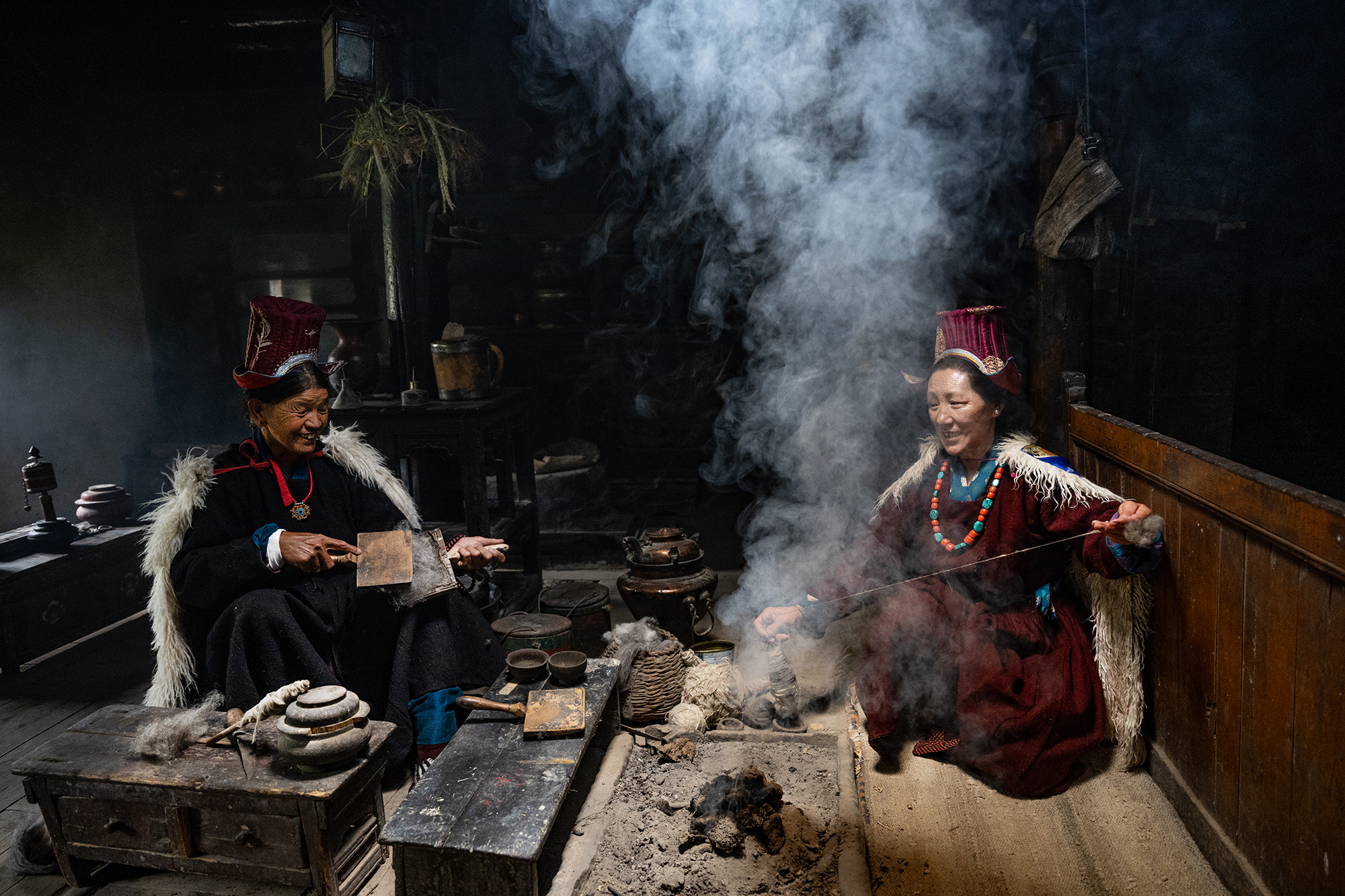
We start the day with a concept shoot of Ladakhi tribal women inside a hundred-year-old traditional Ladakhi house — wooden beams, low light, kitchen hearths, and heirloom textiles offering a richly textured interior environment for portraiture. After the shoot we begin the journey to Nubra Valley (170 km / 6 hours' drive). En route we cross Khardung La pass, one of the highest motorable roads in the world.
In the afternoon we arrive in Nubra for a sunset shoot — sand dunes, double-humped camels, and warm low light across the valley floor. Night stay at Nubra Valley.
Photographic Opportunities: Interior portraits in heirloom Ladakhi attire amid wooden beams, hearths, and aged textures of a century-old home. At Khardung La: prayer flags, summit signage, and high-altitude road frames. In Nubra: golden sand dunes, Bactrian camels, oasis villages, and warm low-angle sunset light shaping the desert ridges.
Accommodation: Hotel Karma Inn, Nubra Valley
Meals: Breakfast/Lunch /Dinner
Day 8 – 17th July 2027 – Diskit Monastery & Pangong Lake
We start early for Pangong Lake (270 km / 7 hours' drive). On the way we visit Diskit Monastery, dating from the fourteenth century — the largest and oldest gompa in Nubra Valley. Its most prominent attraction is the huge Maitreya Buddha statue atop the site.
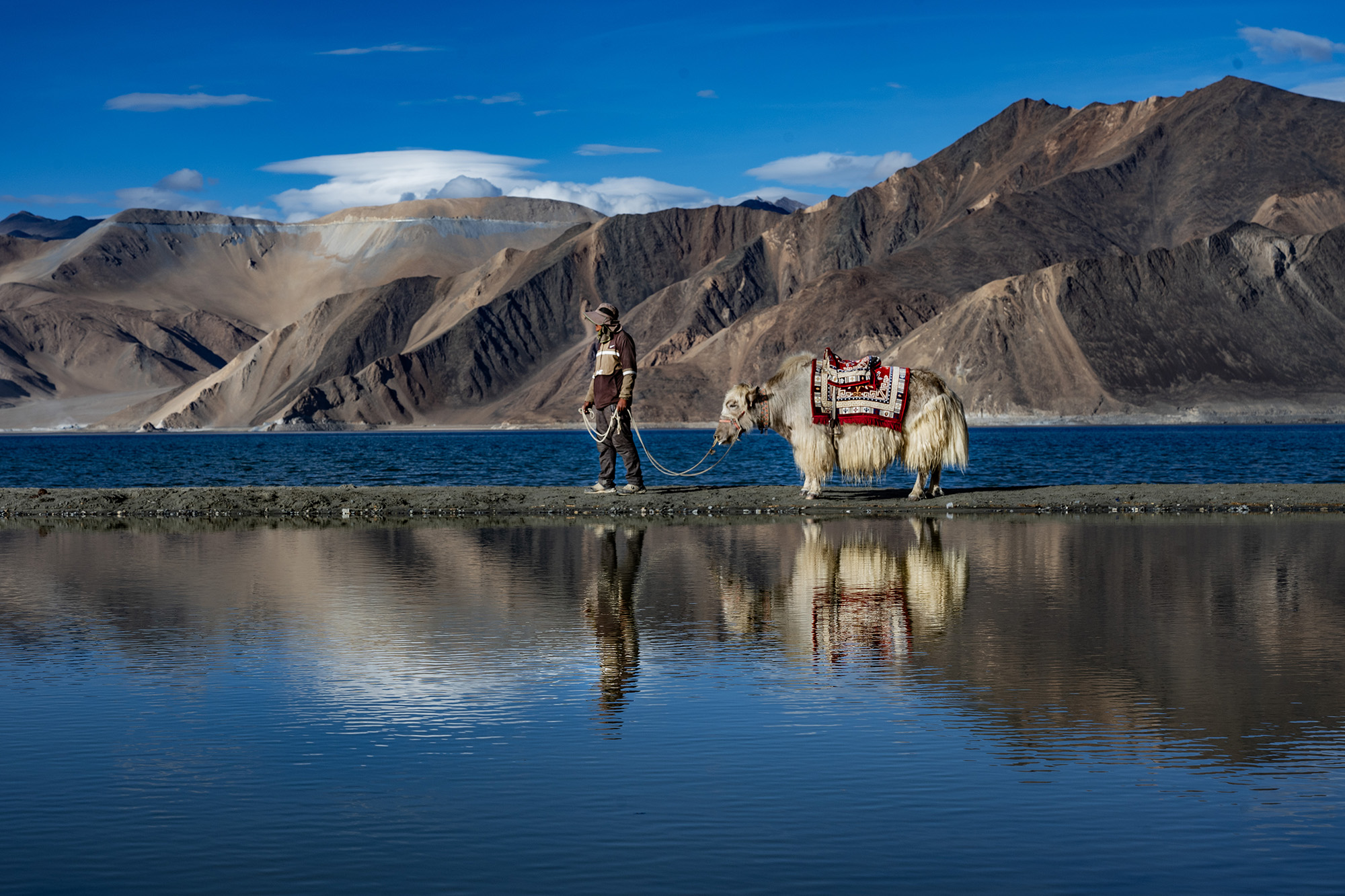
We reach Pangong Lake by late afternoon. In the evening we shoot the sunset on this celebrated high-altitude lake, whose water shifts through blues, turquoise, and violet as light fades. Night stay beside Pangong Lake.
Photographic Opportunities: The Maitreya Buddha against open sky, monastery prayer-flag corridors, monk portraits, and Nubra Valley vistas from Diskit's height. At Pangong: long-exposure water studies, layered mountain reflections, the evolving colour palette through sunset, and minimal compositions of shoreline, sky, and the lake's narrow ribbon of blue.
Accommodation: LG Resort Pangong, Pangong Lake
Meals: Breakfast/Lunch /Dinner
Day 9 – 18th July 2027 – Pangong Lake Sunrise to Tsomoriri – Changpa Nomad Portraits
We rise before dawn for a sunrise shoot near Pangong Lake, the saline water shifting through blues and turquoise as the light climbs over the surrounding peaks. After breakfast, we set out on the six-hour drive across the Changthang plateau toward Tsomoriri, one of Ladakh's most remote high-altitude lakes.
En route, we stop to photograph the Changpa community, semi-nomadic herders whose lives are built around pashmina goats, yak, and the demands of altitude. This portrait shoot is conducted with care, allowing time to observe dress, tents, and daily routines before framing our images. We arrive at Tsomoriri by evening and settle in for the night beside the lake, the plateau's silence and scale setting the tone for the following morning's exploration.
Photographic Opportunities
Sunrise over Pangong Lake as its saline water shifts through blue and turquoise; sweeping Changthang plateau landscapes en route; Changpa nomads herding pashmina goats and yak, portraits in traditional dress, tents and pastoral settlements offering unhurried, close documentary access.
Accommodation: Tsomoriri Lake
Meals: Breakfast/Lunch /Dinner
Day 10 – 19th July 2027 – Tsomoriri Dawn and Korzok Monastery – Return to Leh
Early morning is dedicated to exploring the beauty of Tsomoriri lake in its stillest light, followed by a further visit to Changpa community settlements for portrait photography, building on the previous day's encounter with additional time to work with willing subjects.
After breakfast, we visit Korzok monastery, perched above the lake, before beginning the long return journey to Leh, a drive of seven to eight hours across the Changthang plateau and its mountain passes. The transition from nomadic settlement to monastic architecture within a single morning offers strong contrast for documentary sequencing. We arrive back in Leh by evening for an overnight stay, closing out the remote high-altitude portion of the tour.
Photographic Opportunities
Dawn light over Tsomoriri's still water; further Changpa settlement portraits, textiles, and livestock; Korzok monastery's architecture, monks, and prayer flags against the lakeshore; open highland scenery along the return route to Leh.
Accommodation: Leh
Meals: Breakfast/Lunch /Dinner
Day 11 – 20th July 2027 – Alchi, Likir and Basgo Monasteries – Leh Market Evening
We spend a relaxed day exploring three of the monasteries near Leh: Alchi, Likir, and Basgo. Alchi holds some of Ladakh's oldest surviving Buddhist wall paintings, an eleventh-century archive of mural work rarely matched elsewhere in the region. Likir is distinguished by its monumental gilded Buddha statue, a landmark visible across the surrounding valley.
Basgo, once the seat of a Ladakhi royal dynasty, presents a weathered fortress-temple whose eroded walls and ruined chapels offer a different photographic register from the earlier, better-preserved sites. In the evening, we relax at Leh market, a final unscripted opportunity for street photography and portraiture among traders, shopkeepers, and everyday city life. Overnight stay at Leh.
Photographic Opportunities
Alchi's eleventh-century murals and carved woodwork; Likir's monumental gilded Buddha against valley scenery; Basgo's weathered fortress ruins and chapels; candid street photography at Leh market, traders, spices, textiles, and everyday city life at dusk.
Accommodation: Leh
Meals: Breakfast/Lunch /Dinner
Day 12 – 21st July 2027 – Departure – Farewell to Ladakh
Our trip concludes after breakfast, closing two weeks of photography across Ladakh with a full collection of images and memories. We transfer for the flight back to Delhi, marking the end of the tour.