;
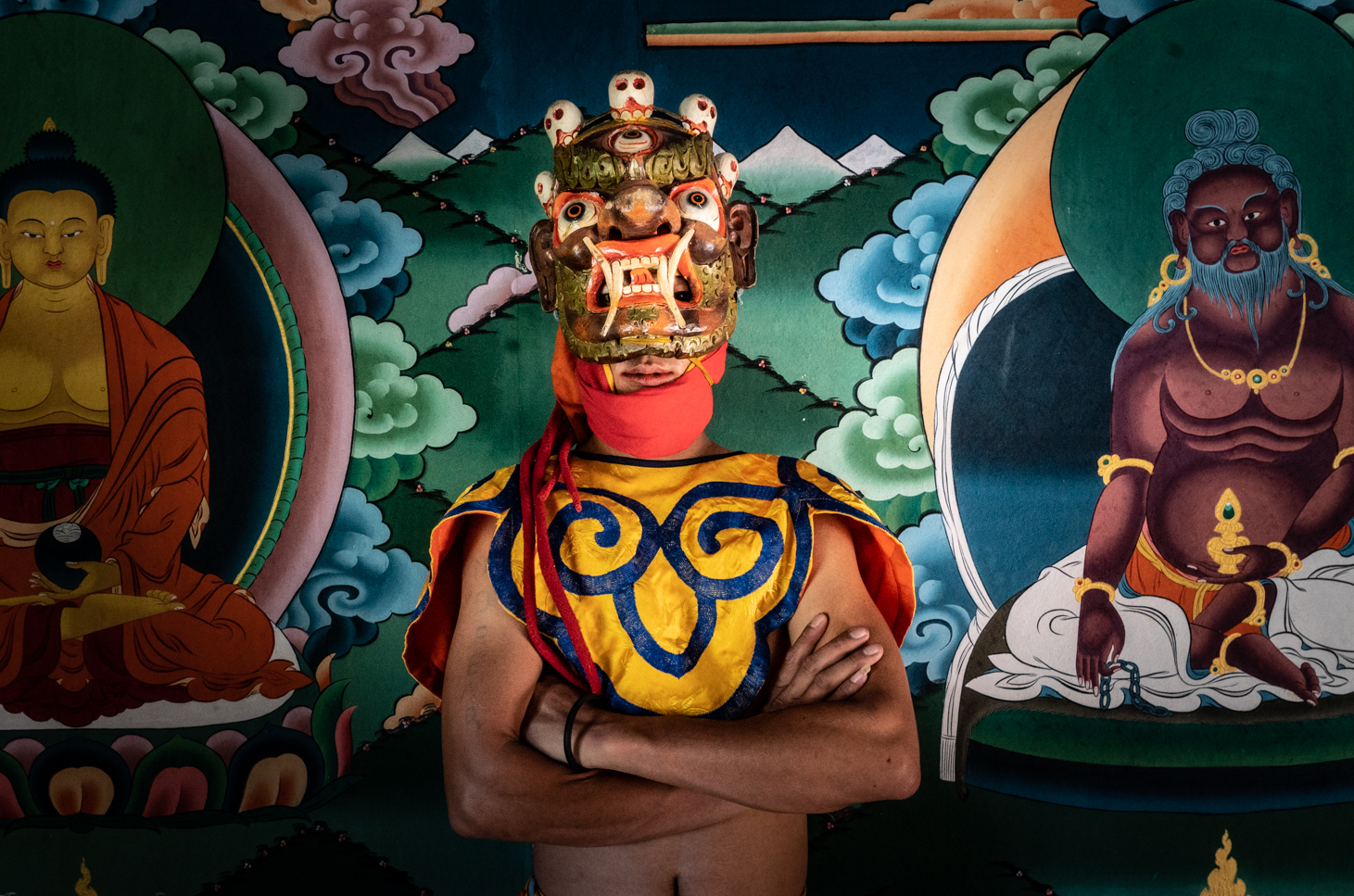
Man posing in Bhutan photo tour Closed


Bhutan Photo Tour

Our Bhutan Festival Photo Tour 2026 offers a profound encounter with one of the world’s last intact Buddhist cultures — a journey designed for photographers who seek meaning beyond the image. It is an experience built around ceremonies, human connection, and the contemplative rhythm of Bhutan’s spiritual life.

In this carefully crafted itinerary, the Paro Tshechu Festival becomes the perfect pretext to orchestrate a series of rare, one-to-one encounters that reveal Bhutan’s most intimate and authentic side. Beyond the spectacle of masked dances and silken costumes, this journey unfolds through private moments — sharing breakfast with monks in centuries-old monasteries, photographing local families inside their ancestral farmhouses, and witnessing traditional musicians and dancers perform exclusively for our group during a cultural evening in Thimphu.

Each activity has been designed to go far beyond the ordinary: access to sacred prayers during temple festivals, private photo sessions inside some of Bhutan’s most impressive Dzongs, and encounters with villagers whose daily lives still reflect the grace of another century. A traditional lunch at a farmhouse followed by an archery match offers a lively window into Bhutanese conviviality, while the ritual hoisting of prayer flags at Dochula Pass connects us to the country’s spiritual essence amid sweeping Himalayan views. Evenings end beside a bonfire, where music, dance, and storytelling merge into a final tribute to Bhutan’s enduring soul — a journey not of sightseeing, but of genuine human connection and privileged cultural immersion.

Our itinerary follows the arc of the Paro Tshechu, the country’s most important religious festival, unfolding through a sequence of intimate encounters with artisans, monks, and villagers. With private access to a cultural performances, private photo sessions, a dinner in national dress, and monastic ceremonies open a window into Bhutan’s intangible heritage.

In the capital, encounters with local craftspeople and students of the Choki Traditional Art School introduce the legacy of the Zorig Chusum, Bhutan’s thirteen classical arts. Here, the camera becomes a tool of observation and respect — recording the precision of a brushstroke, the meditative rhythm of hands at work, the humble pride of young artists continuing an ancient lineage.

Between ceremonies, quieter opportunities arise: the butter-lamp offerings of dawn, the turning of prayer wheels, portraits of pilgrims, and conversations shared over tea in remote villages. In these pauses, Bhutan reveals its true generosity — an unhurried kindness that welcomes observation without performance.

Bhutan, or Druk Yul — “The Land of the Thunder Dragon” — remains one of the last true sanctuaries of Himalayan spirituality. Hidden between India and Tibet, it is a realm of high mountains, pure air, and an enduring Buddhist culture. In every valley, fortress-monasteries rise like living symbols of faith, prayer flags dance against the sky, and crimson-robed monks chant beneath flickering butter lamps.

Watch The Bhutan Video

HIGHLIGHTS

  • The sacred Paro Tshechu Festival, with its masked dances, silk costumes, and centuries-old rituals of blessing and devotion.
  • Private photo sessions and cultural performance with traditional dinner in Thimphu, featuring masked dancers and musicians in national dress.
  • Private photo sessions in local farm old houses with locals dressed in traditional dresses
  • Morning breakfast in a monastery with the monks
  • Farm Houses and villages, preserved in time, a slice of life from the 16th and 17th century still living and used today as they always have been.
  • The incredible Taktshang Monastery, the Tiger’s Nest
  • Local people engaged in daily activities, and authenticity.
  • Prayer wheels and flags pepper the land, evidence of how interwoven the culture and religion are in this area.
  • Our photo sessions in some of the most overwhelming of Dzongs in Bhutan
  • The impressive views at high passes
  • Sacred priers at the temple festivals
  • Prayer flag hoisting at Dochula pass, enjoying the magnificent mountain views.
  • Lunch at a typical village farmhouse, followed by game of Archery
  • Evening cultural program at the hotel amidst bon-fire.
The best thing for me about my trip to India was the staff. it wasn’t some academic kind of ordeal. I really didn’t want a trip that was going to be an ‘educational’ vacation. They did help me when needed, and the photo review sessions were great – I loved seeing everyone else’s shots and talking about them. But I was happy also that I got to do my own thing and that we weren’t locked into a strict routine. We saw a lot of interesting and curious things, and I’d like to go back and explore the places I didn’t get a chance to go.

A.L. Thompson


ITINERARY


Day 1 – March 25, 2026 (Wednesday): Arrive Delhi

Arrival in Delhi. Upon landing, our representative greets the group and transfers us to the hotel for check-in. Rooms are available from 14:00 hrs. The rest of the day is at leisure to rest and prepare for the flight to Bhutan the following morning.

Overnight in Delhi
Accommodation: Pride Plaza Aerocity (or similar)
Meals: None

Photographic Opportunities

First impressions of India’s contrasts between modernity and tradition, glimpses of Delhi’s energy and architecture, evening city lights and street scenes around the hotel.


Day 2 – March 26, 2026 (Thursday): Delhi – Paro (Flight) – Thimphu (Drive 55 km / approx. 2 hrs)

Early transfer to the airport for our flight to Paro. As the aircraft crosses the Himalayas, we see the peaks of Everest, Kanchenjunga, and Bhutan’s sacred mountains.

Upon arrival, we meet our Bhutanese guide and begin the drive toward Thimphu, the capital of Bhutan. En route, we stop at Tachog Lhakhang, a temple founded by Thangtong Gyalpo, the builder of Bhutan’s iron suspension bridges. We cross his centuries-old bridge adorned with prayer flags and continue to Chuzom, where the Paro and Thimphu rivers meet beneath three stupas in distinct Bhutanese, Tibetan, and Nepali styles.

After check-in and lunch in Thimphu, we visit Buddha Point (Kuensel Phodrang), where the immense golden Buddha dominates the valley. Later, we stop at the Memorial Chorten, where devotees spin prayer wheels and walk clockwise around the stupa in constant meditation.

Also witness a Traditional cultural Performance, a vibrant and captivating display of the kingdom´s rich heritage and deeply rooted customs. Adorned in colourful traditional attire, dancers gracefully weave stories from mythology, folklore, and daily life, accompanied by the enchanting sounds of traditional musical instruments like the dramnyen, flute, and drums.

Overnight in Thimphu
Accommodation: Access Suites / Hotel Osel (or similar)
Meals: Breakfast, Lunch, Dinner

Photographic Opportunities

Himalayan vistas from the flight, the suspension bridge and temple at Tachog Lhakhang, rivers and stupas at Chuzom, prayer rituals at the Memorial Chorten, and the vibrant scenes of the private traditional dinner and cultural performance.


Day 3 – March 27, 2026 (Friday): Thimphu

After breakfast, we visit the Choki Traditional Art School, a nonprofit institution dedicated to preserving Bhutan’s traditional arts while providing education and lodging to children from disadvantaged families. 

The experience at Choki Traditional Art School is a profound immersion into Bhutan’s spiritual and artistic heritage. The visit begins with a sacred butter lamp lighting ceremony before the statue of Guru Rinpoche, symbolizing enlightenment and peace—a moment that sets a contemplative tone for the day. Guests are then introduced to the school’s inspiring mission through a short documentary while enjoying a cup of signature mint tea, learning how this institution preserves Bhutan’s ancestral crafts and empowers young artisans. A hands-on workshop follows, where participants, guided by senior students, create their own traditional paintings to take home as meaningful keepsakes. 

This tradition deepens inside a 17th-century building, consecrated by Druk Desi Tenzin Rabgye and blessed by the Divine Madman, whose sacred presence infuses the space with history and devotion. The visit culminates with live demonstrations of Bhutanese craftsmanship—Lhadi painting, sculpting, wood turning, bamboo work, textile weaving, tailoring, and embroidery—offering an intimate encounter with the timeless skills and creativity that define Bhutan’s artistic soul.

We join a hands-on painting session guided by senior students and visit a 340-year-old building within the school, consecrated by Druk Desi Tenzin Rabgye and blessed by the Divine Madman. The experience includes live demonstrations of wood-turning, bamboo craft, tailoring, and embroidery.

After lunch, we proceed to Pangri Zampa Monastery, built in 1529, where astrologer monks read celestial charts and offer predictions. The afternoon continues at Kaja Throm, Thimphu’s revitalized market district, alive with artisans, food stalls, and street scenes. Later, we visit Trashichhoedzong, the majestic “Fortress of the Glorious Religion,” which houses the King’s throne room and the seat of the Chief Abbot.

In the evening, we explore the Local Craft Bazaar and then take a short driving tour of Thimphu’s illuminated monuments.

Overnight in Thimphu
Accommodation: Access Suites / Hotel Osel (or similar)
Meals: Breakfast, Lunch, Dinner

Photographic Opportunities

The butter-lamp lighting ceremony at Choki Art School, artisans working on traditional crafts, portraits of monks during astrology readings at Pangri Zampa, bustling activity at Kaja Throm, sunset and night images of Trashichhoedzong, and the illuminated streets and markets of Thimphu.


Day 4 – March 28, 2026 (Saturday): Thimphu – Gangtey (Phobjikha Valley) (Drive 150 km / approx. 5 hrs)

After breakfast, we begin the journey toward Gangtey, crossing Dochu La Pass at 3,088 meters. We stop to admire the 108 chortens, prayer flags, and sweeping Himalayan views. A prayer flag hoisting ceremony takes place at the pass, surrounded by magnificent mountain scenery. If the sky is clear, we see peaks such as Masagang, Terigang, and Gangkar Puensum, the highest in Bhutan.

We continue to Gangtey, stopping for lunch at Punakha or Wangdue. On arrival, we check in at the hotel and explore the Phobjikha Valley, winter home of the black-necked cranes. In the afternoon, we visit Gangtey village, share yak butter tea with local families, and learn about their life in this remote valley.  

In the mountains east of Wangduephodrang lies the beautiful Phobjikha valley, on the slopes of which is situated the great monastery of Gangtey, established in the 17th century. The village of Phobjikha lies a few km, down from the monastery, on the valley floor. This quite, remote valley is the winter home of black necked cranes, which migrate from the arid plains of Tibet in the north, to pass the winter months in a milder climate. The birds start arriving here from November  onwards and usually stay till early March.

The valley of Gangtey is one of the most beautiful spots in Bhutan. The surprise of finding such a wide, flat valley without any trees after the hard climb through dense forests is augmented by
an impression of vast space, and extremely rare experience in Bhutan where most of the valley’s are tightly enclosed.

Later, we attend a prayer ceremony at Gangtey Monastery. The day’s photographs capture pastoral life, portraits of villagers and monks, and sweeping Himalayan vistas.  A profound and peaceful experience that connects us to the valley’s spiritual essence.

Overnight in Gangtey (Phobjikha Valley)
Accommodation: Namgayling Cottage / Phobjikha Hotel (or similar)
Meals: Breakfast, Lunch, Dinner

Photographic Opportunities

The prayer flag hoisting ceremony at Dochu La, panoramic mountain views, pastoral life in Gangtey village, intimate moments during tea with locals, and the private prayer ceremony at Gangtey Monastery.


Day 5 – March 29, 2026 (Sunday): Gangtey (Phobjikha Valley) – Punakha (Drive 85 km / approx. 3 hrs)

Dawn finds us back at Gangtey Monastery for prayers. Afterwards, a visit to Gangtey Goenpa leads into the Gangtey Nature Trail, a gentle two-hour walk through meadows, villages and pine forests.

The trail covers roughly 3.5 miles, blending nature, culture and landscape. Time is also spent at the Black-Necked Crane Information Centre and Wangduephodrang Dzong, where we photograph monks, villagers, cranes, and local life. 

Post lunch, drive to Punakha. Before reaching Punakha, make a short stop at Wangduephodrang Dzong, founded in 1638 by Zhabdrung Ngawang Namgyal. Perched on a ridge overlooking Punak Tsang Chhu and Dang Chhu, it once gave its governor control over key routes to Trongsa, Punakha, Dagana, and Thimphu. Damaged by fire in 2012, the dzong was fully restored in 2022.

Overnight in Punakha
Accommodation: Zen Punakha / Meri Puensum Resort (or similar)
Meals: Breakfast, Lunch, Dinner

Photographic Opportunities

The morning prayer ceremony at Gangtey Monastery, landscapes along the Gangtey Nature Trail, cranes and wetland views at the Information Centre, and the scenic dzong at Wangduephodrang.


Day 6 – March 30, 2026 (Monday): Punakha

Breakfast is shared with monks at Chorten Ningpo Monastery, offering candid images of monastic life. We then walk through rice fields to Chimi Lhakhang; participants may start from the main road or shorten the approach by driving closer and walking about fifteen minutes each way.

In the afternoon, we hike to Khamsum Yulley Namgyal Chorten, a moderate 2 km ascent, where panoramic views of the Mo Chhu valley and terraced farms await. Throughout the day, our cameras capture monks, local villagers and Punakha’s distinctive architecture.

Overnight in Punakha
Accommodation: Zen Punakha / Meri Puensum Resort (or similar)
Meals: Breakfast, Lunch, Dinner

Photographic Opportunities

Breakfast and ceremony with monks at Chorten Ningpo, the majestic architecture of Punakha Dzong, local life on the path to Chimi Lhakhang, and views from Khamsum Yulley Namgyal Chorten.


Day 7 – March 31, 2026 (Tuesday): Punakha – Paro (Drive 125 km / approx. 4 hrs)

After breakfast, we drive to Paro, arriving for lunch at a local farmhouse, followed by a friendly archery game, Bhutan’s national sport.

The afternoon includes visits to Ta Dzong, the former watchtower now serving as the National Museum, and then walk down the trail to visit Rinpung Dzong (or Paro Dzong), meaning (“fortress of the heap of jewels”), which has a long and fascinating history. Along the wooden galleries lining the inner courtyard are fine wall paintings illustrating Buddhist lore such as four friends, the old man of long life, the wheel of life, scenes from the life of Milarepa, Mount Sumeru and other cosmic Mandalas.

We then explore Paro town before returning to the hotel. Throughout the day, our cameras capture monks, local villagers and Punakha’s distinctive architecture.

Overnight in Paro
Accommodation: Himalayan Keys Forest Resort / Tenzinling Resort (or similar)
Meals: Breakfast, Lunch, Dinner

Photographic Opportunities

Rural scenes on the road to Paro, the archery match at the farmhouse, exhibits at the National Museum, frescoes at Rinpung Dzong, and street life in Paro.


Day 8 – April 1, 2026 (Wednesday): Paro – Paro Tshechu Festival and Tiger’s Nest

Following breakfast, we attend the Paro Tshechu Festival, one of Bhutan’s grandest religious celebrations, featuring monks and laymen performing sacred mask dances at Paro Dzong.We focus our lenses on dancers, devotees, and vivid costumes. 

Paro Tshechu is one of the most popular festivals in Bhutan, held annually since the 17 th  century when Zhabdrung Ngawang Namgyal, the founder of the state of Bhutan, and Ponpo Rigzin
Nyingpo initiated the festival together with the consecration of Paro Dzong (fortress) in 1644. Featuring dances performed by trained monks and laymen in amazing masks and costumes, Paro Tshechu (festival) is one of the best ways to experience the ancient living culture of Bhutan.

In the afternoon, we hike to Taktsang Monastery (Tiger’s Nest), Bhutan’s most iconic site, built on a cliff 900 meters above the valley. The round trip takes about five hours with plenty of time for photography.

Overnight in Paro
Accommodation: Himalayan Keys Forest Resort / Tenzinling Resort (or similar)
Meals: Breakfast, Lunch, Dinner

Photographic Opportunities

Colorful mask dances and costumes at the festival, portraits of monks and devotees, and breathtaking views of Tiger’s Nest Monastery and its dramatic setting.


Day 9 – April 2, 2026 (Thursday): Paro – Paro Tshechu and Thongdroel Ceremony

Early morning at dawn we witness Thongdroel ceremony. A highlight of Paro Tsechu is the unfurling of the silk Thangkha – so large that it covers the face of an entire building and is considered one of the most sacred blessings in the whole of Bhutan. The ‘Thangkha, known in Bhutan as a ‘thongdroel’ is a religious picture scroll, and is only exhibited for a few hours at daybreak on the final day of the festival enabling the people to obtain its blessing. This holy scroll ‘confers liberation by the mere sight of it’ (the meaning of the word ‘thongdroel’ in Bhutanese).

We then document the festival’s final dances and blessings before visiting Drukgyel Dzong and Kyichu Lhakhang. The day concludes with photographs of mountain vistas, sacred rituals and pilgrims in prayer.

Accommodation: Himalayan Keys Forest Resort / Tenzinling Resort (or similar)
Meals: Breakfast, Lunch, Dinner

Photographic Opportunities

The sacred Thongdroel Ceremony at dawn, final festival dances and blessings, mountain views from Drukgyel Dzong, and pilgrims at Kyichu Lhakhang.


Day 10 – April 3, 2026 (Friday): Paro – Delhi (Flight) – Departure

After breakfast, transfer to Paro Airport for the flight to Delhi. Upon arrival, connect with international flights for onward travel.

Meals: Breakfast

Photographic Opportunities

Last views of Paro Valley from the air, the Himalayas seen at sunrise, and quiet reflections marking the end of the journey.


Prices per person
6-8 Participants 10,700 US$


Supplements
Single room supplement Bhutan 700 US$


WHAT'S INCLUDED


Prices are per person, based on double occupancy. A limited quantity of single-occupancy rooms is available for an additional charge.


The maximum number of participants is listed under "Maximum Group" in the Price section of each individual workshop. However, we reserve the right to add by up to one the maximum number of participants per workshop at any time.


INCLUDED


  • - Tutoring by photographer with Harry Fisch and/or Roberto Pazzi
  • - All meals in Bhutan except the day of arrival and departure
  • - All specified transfers and transportation
  • - Private air-conditioned vehicle during the tour.
  • - Accommodation in 3 /4 Stars and tourist class hotels.
  • - Hired Models
  • - All activities and visits specified in the itinerary
  • - English speaking guide


SERVICES NOT INCLUDED


  • - International Flights
  • - Flight Dehi-Paro-Delhi  ( Aprox. 650 US$), We will book it on your behalf
  • - Tips to guides/drivers
  • - Personal extras, such as drinks, laundry, telephone, etc.
  • - Visas.
  • - Airport taxes
  • - Any other item not mentioned as included


ACTIVITY LEVEL-


Level 2.- This trip requires a reasonable degree of fitness. Participants should be capable of walking at different times of the day, primarily while taking pictures, at a comfortable pace. The standard duration for a walk is often one hour. Additionally, they should be able to stand for extended periods and independently embark and disembark from coaches, planes, and trains.

 You must be able to carry your own luggage, climb and descend stairs, moderate walking on uneven surfaces.


A couple of unique, easy-paced photographic-walks have been specially organized for this journey.


Day 5.- Morning walk on the Gangtey Nature Trail (approx. 3.5 miles). It’s a gentle, easy walk and suitable for all participants. With a perfect blend of nature, culture and landscape, its one of Bhutan’s most scenic and accessible short walks.


Day 6 – Punakha Walk to Chimi Lhakhang Temple (about 30 minutes each way). Its a gentle, gradual walk-through paddy fields and picturesque villages, providing ample photo opportunities. One can walk directly from the main road or drive all the way to the base of monastery followed by 15 minutes walk each way and one to Khamsum Yulley Namgyal Chorten (approx. 2 hours round trip). 


It is a moderate, steady uphill climb with distance of 2km each way. Its offers panoramic view of the Mo Chhu River valley, Punakha’s fertile farmland and terraced rice fields. The chorten’s rooftop view point is one of Punakha’s best vantage points for photography.


TIGER NEST HIKE.- (Four/Five hours with breaks. Porters coming with us)


For  those who prefer not to do the hike, we have an alternative activity. 


The hike to Tiger’s Nest Monastery (Paro Taktsang) is of moderate difficulty and suitable for travelers in average physical condition. The round trip covers about 6 kilometers, with an elevation gain of around 700 meters, reaching up to 3,120 meters above sea level. The ascent usually takes 2 to 2.5 hours and the descent about 1 to 1.5 hours, making a total of 4 to 5 hours.


After about 1.5 to 2 hours, hikers reach the cafeteria viewpoint, an ideal place to rest, enjoy tea, and take in magnificent views of the monastery. From there, it takes another 45 minutes to 1 hour to reach the temple itself. The path alternates between dirt trails and stone steps, with several steep sections that require steady pacing and balance.


During or after rain, parts of the trail can become muddy and slippery, so good hiking shoes, poles, and a light rain jacket are highly recommended. 

For those who prefer a shorter walk, it is perfectly fine to stop at the cafeteria, enjoy the views, and return from there.