
Uzbekistan Photo Tour
7,400 US$
An intense photographic tour across Uzbekistan. A trip with a plethora of photographic opportunities, mausoleums, minarets and walled enclosures. We will be interacting with the local population and capture with our camera the atmosphere of this incredible culture. The date has been chosen to coincide with a Kupkari game on the Navruz festivities. A traditional […]
Download the PDF
HIGHLIGHTS
- Our stay in Khiva within the walls of the Ichan-Kala fortress
- Photo session with girls in a village wearing the wedding dresses
- Samarkand and the real Uzbek style of life
- We will be looking for a Kupkari tournament (please see "Trip Details"notice)
- A meal in a village house with the family sharing a typical Uzbek lunch.
- Tiny alleyways, mosques, minarets, madrassas
- Nurata, a village where pilgrims from all across Uzbekistan come to drink from the mystical spring of Chashma.
- Tashkent and the Soviet-style Metro
An intense photographic tour across Uzbekistan. A trip with a plethora of photographic opportunities, mausoleums, minarets and walled enclosures. We will be interacting with the local population and capture with our camera the atmosphere of this incredible culture.
The date has been chosen to coincide with a Kupkari game on the Navruz festivities. A traditional tournament on horseback in which riders compete for the carcass of a goat and get it into the opponent's goal. It is an exceptional spectacle and one that very few westerners have been able to witness.
According to the global law and order report 2020, Uzbekistan is ranked as the 10th safest nation in the world ahead of countries such as Canada and Germany itself.
A photo tour to Uzbekistan is a trip to the heart of the Silk Road, the most appealing of the Central Asian republics, once in the Soviet orbit and now a country of tolerant practices with the vast majority of its inhabitants professing the Muslim faith.
Uzbekistan has always stood out for its cultural heritage, the result of a historical trajectory that includes everything from Alexander the Great to Genghis Khan and Tamerlane, and for its trade vocation. For centuries, the Silk Road served as a highway along which not only goods traveled and were later exhibited at the fairs and markets of Venice or Seville, but also culture, as evidenced by the appearance of doctors such as Avicenna.
In addition to the mausoleums, minarets and walled enclosures that punctuate the circuit, there are claims that can hardly leave indifferent. The Chorsu Bazaar and the Kudeldash Madrasa, in Tashkent, contrast with the ultramodern metro, with stations that have nothing to envy to those of Moscow.
In Samarkand, the Ulugbek astronomical observatory and Reguistan Square, the most fabulous square in Central Asia, a crossroads of roads and madrasas. In Shakhrisyabz -like the previous one, a World Heritage Site-, Tamerlane's summer palace and his family's funerary complexes.
In Bukhara, the medieval city and bazaars are dominated by turquoise domes and madrasas such as Nodir Devan Begi offer dance performances. And Khiva, two cities enclosed within as many concentric rings, the most spectacular of which is a brick wall, which houses palaces, minarets and mosaics, and which is of all the cities that best preserves its ancient flavor.
My trip with Harry was an experience beyond anything I could imagine. The locations and itinerary are extremely well thought out and organized to maximize your photographic opportunities. Harry’s advice and approaches to evaluating a scene and working your subject were invaluable. It took me outside of my comfort zone culturally and technically and as a result, I returned with some of the most dramatic and moody photographs in my collection.
Mike Benford United States
ITINERARY
13 March.- Tashkent – Flight to Urgench- Khiva
Our representative will be meeting you on arrival. Transfer to hotel.
In the afternoon we will be Flying for Khiva, next to the Urgench airport. If time allows we will start visiting the city before dinner and later go for a sunset.
14 March.- Khiva
Early sunrise session.
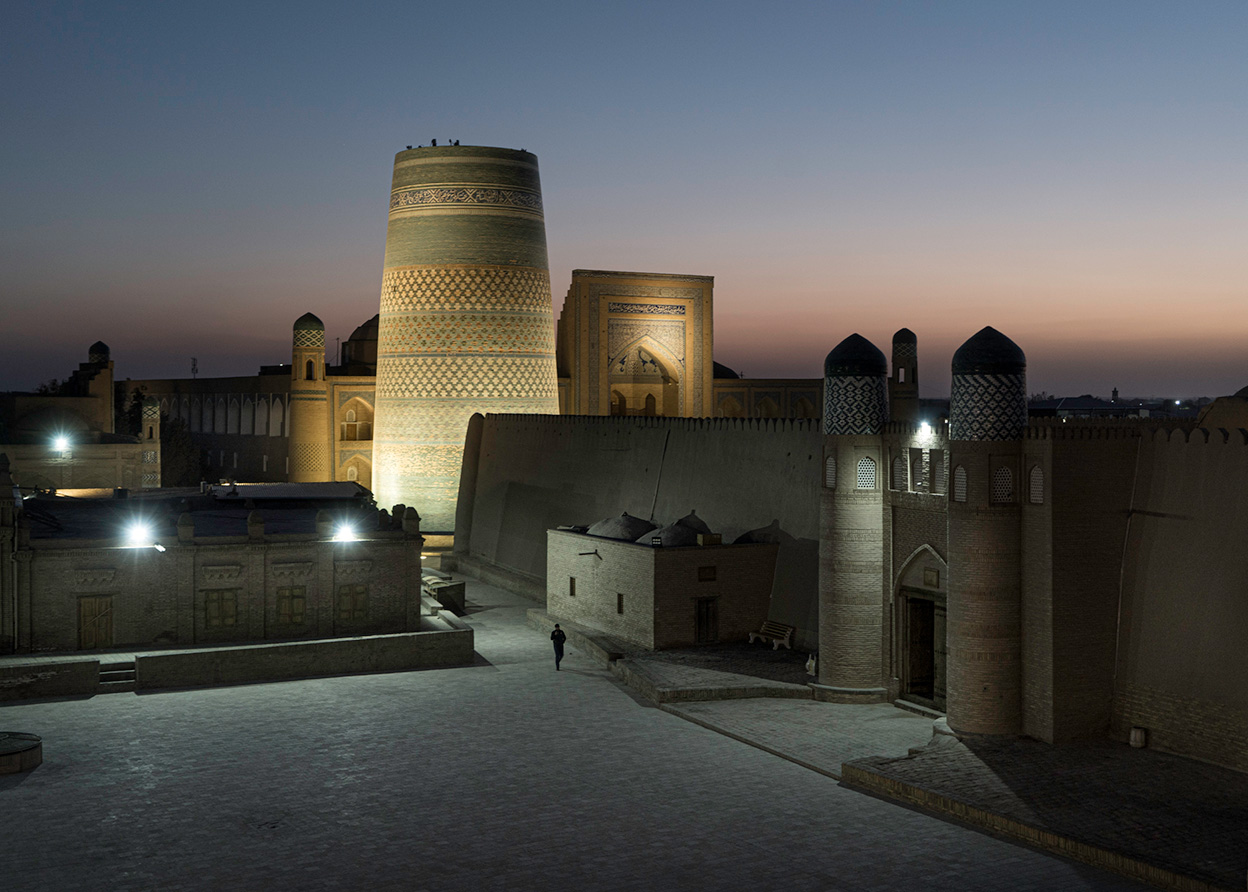
Khiva is settled in the middle of the Kyzylkum and Karakum deserts, and was founded in the 5th or 6th centuries. The place became recognized as a modest trading stop on the Silk Road. Not until the 16th century did the majority of Khiva's enormous architectural projects begin, and the town defined itself as a regional center of power.
Photographic opportunities unfold before our eyes with local visitors wandering around the city as well as pilgrims. We will photograph domestic tourists coming from remote regions, often in attire that is still only seen in villages. Long tunics consisting of a loose cotton coat, called chapan. The chapan is long-sleeved, knee-length or longer, and is made of cloth with a variety of colored stripes.
Our accommodation is strategically located within the Ichan-Kala fortress, which was the first site in Uzbekistan and Central Asia to be designated as a UNESCO World Heritage Site. This is a photo tour to Uzbekistan where the opportunities are appearing opening the door of our hotel. As we walk through the narrow labyrinthine streets, we will get a sense of how crowded and bustling this town must have been in the past.
15 March. - Khiva
We'll be out early in the morning strolling and photographing the historic city with its tiny alleyways, mosques, minarets, and an old graveyard set against the city walls.
We have many chances to witness a typical wedding ceremony. Khiva is a favorite destination for weddings and it is not uncommon to see parades in the street and the occasional visit to the mosque by the bride and groom-to-be. In addition to the extraordinary architectural and cultural beauty, daily life offers photographic opportunities: from a street celebration to a communal meal.
The city is home to 54 massive historical structures and 250 historic residences. It is going to be an unforgettable experience. With 94 mosques and 63 mosques, Khiva is regarded as an important Islamic center.
The day in Khiva concludes with a folk show and dinner at Khiva Khan Toza Bog's summer home.
16 March .- Khiva - Bukhara.
Morning Filght to Bukhara. Arrival and Check-in.
Bukhara has a number of well-preserved walls and gates, and you may see these ancient landmarks during our photo tour experience.
Again, around the extraordinary buildings and streets of this landmark on the Silk Road, we will seek to meet the pilgrims visiting the mausoleums, mosques and necropolises. It is tradition for devout Muslims to pray at the tombs of the great guides of Islam. We will also provoke occasions to witness, as much as possible, the local life and immortalize the events with our cameras.
We'll also go to the Kosh Madrasah, which consists of two Abdullah Khan and Modar-i-Khan madrasahs, the Poi-Kalon ensemble, and a visit to one of the working madrasahs, one of the most prominent Islamic educational institutions in the post-Soviet environment. We will visit as well the Chor Bakr necropolis, one of Uzbekistan's biggest architectural groupings.
17 & 18 March - Bukhara
After breakfast, we'll continue our fascinating photographic discovery of Bukhara's sites. Spectacular ancient mosques, mausoleums, and synagogues, a historic necropolis, dusty backstreets, dilapidated buildings, and a magnificent early Soviet wrought-iron water tower are among the treasures.
We'll stop by a teahouse for a cup of green tea and to take in the atmosphere.
The photo tour in Bukhara will conclude with a visit to the old synagogue and the Jewish quarter.
March 19th. Bukhara - Samarkand
Drive to Samarkand .
We have organized the trip to coincide with the celebration of Navruz. The atmosphere at this time is special. After lunch we will start discovering Samarkand.
Samarkand is one of the world's oldest continuously inhabited cities, approximately 2,750 years old.
Alexander the Great came there in 330 B.C., as part of his campaign to seize the possessions of Darius III. In 1220, Genghis Khan invaded, devastated, and destroyed the city.
When the Uzbeks conquered Samarkand in the 16th century, the capital was relocated to Bukhara. The Persian, Turkish, and Chinese emperors that succeeded them were unable to reverse the city's collapse, which was virtually abandoned two centuries later due to a series of earthquakes.
It was resurrected by the Russians following their annexation of it in 1868 and later Sovietized culturally and scenically.
It would re-enter the world upon Uzbekistan's independence in 1991.
We will have a photo session on our visit to the neighboring Rukhabad and Aksaray mausoleums as well as the Gur-Emir mausoleum. Today's dinner at the Novy Arbat restaurant in Samarkand will feature oven-cooked mutton.
With gorgeous blue tiled walls as a backdrop, photographing the pilgrims is a dream come true. We'll then proceed to Registan Square, which is a genuine gem in the heart of the old city. An incredible architectural photography milestone.
March 20th .- Samarkand.
We will visit a village, document and enjoy the experience of a lunch with a family at their home. In Uzbekistan people in the villages generally live in large families consisting of several generations, so preference is given to large houses built on the land.
The traditional hospitality of the Uzbek people is legendary and the national dish, Plov (made with rice, chunks of meat, grated carrots and onions), is shared at all family events.
The tea ceremony occupies an important place in life as an element of hospitality. And preparing tea and sharing it with guests is the exclusive prerogative of the host. Invitations for lunch and dinner are always accepted and you are expected to arrive on time.
We will later drive to the Khujum silk factory and Konigil village for a tour to a paper mill and dinner with the craftsmen after a brief break.
March 21st.- Samarkand – (Possibly) Kupkari Games
When it comes to public holidays, Navruz is a big one. Public events are held on March 21, however celebrations can stretch for up to two days.
Folk festivals flow over into the streets of villages. Traditional sports tournaments in rural areas draw enthusiastic crowds. Horseback wrestling, equestrian contests, and the national game of kupkari, in which two teams on horseback fight over a goat carcass, are among the most popular.
But it is impossible months in advance to be certain of the times and locations at which a particular activity will take place. The local culture and organization is such that, most of the time, an event like Kupkari is decided a couple of days in advance. We will be vigilant to the possible celebration of the activities and we will adapt our program to the reality on the ground.
We have planned a depart for Urgut, where Kupkari and other celebrations in honor of Navruz could take place.
Following our participation in Kupkari, we will return to Samarkand to wander through the venues for concerts, fairs, and sporting activities.
Our next destination will be a little town with a workshop that makes traditional silk paper from mulberry tree bark. It's a beautiful location where we can capture people engaged in the papermaking process. We will visit and photograph the Gur Amir Mausoleum in the late afternoon.
22 March .- Samarkand – Tashkent.
Early speed train to Tashkent.-
We will go to the subway for a photo session in the Soviet-style stations. The day will be followed by a visit to the huge market, Chorsu Bazaar, where we will enjoy street photography with the local shoppers and the local visitors where they gather outdoors for lunch.
If time permits, we will go to some strategic points of the city to see the daily life and, especially, Plov central restaurant - the famous Uzbek food - where we will document photographically the activity in the kitchens and with the consumers.
Finally, we will have a farewell dinner in a grandiose
Uzbek-Soviet style restaurant, ending our cultural and photographic immersion in Uzbekistan.
Tashkent, 23 March
Transfer to the airport for our return trip home after breakfast.
EXTENSIONS
Aral Sea Extension (23 Mar 2023)
The minimum number of participants for this photo tour will be 5 people.
For the more adventurous this five days photo expedition to the area and the Aral Sea. The possibility of documentary photographs and a different experience.
It is a remote region, and we will have long and interesting itineraries in our 4x4. It is more a photographic expedition than a photo tour. An excuse to witness what the human being can eventually damage in his intervention on nature through industrial policies. Villages of clear soviet profile semi abandoned or reconstructed that do not give the impression of being lived, empty remote landscapes, the feeling of neglect and remoteness of a civilization that has gradually abandoned the region.
We will be sleeping in basic hotels with decent "western" comfort and one or two nights in yurts once we arrive to the camp in the Aral sea. All very basic.
DAY 1- March 23.-Tashkent – Nukus – Aral Sea
Drive to Nukus from Khiva with a visit en route old ruins of Toprak Kala, Ayaz Kala.
Leaving Urga, we’ll eventually enter the mighty Ustyurt Plateau, an endless transboundary clay desert shared by Turkmenistan, Uzbekistan and Kazakhstan.
Visit the Kubla Ustyurt settlement (a small village built in Soviet times in the middle of Ustyrt Plateau).
From Kubla we’ll then descent to the current shores of the legendary Aral Sea: formerly the fourth largest lake in the world, the Aral Sea has been shrinking since the 1960s after the rivers that fed it were diverted by Soviet irrigation projects.
The southern shoreline of the Aral Sea, our goal for the day, is now more than one hundred miles further north than it used to be and what’s been left behind is a somber windswept desert named Aral Kum (Aral sands), while former fishing towns along the original shores have now become ship graveyards.
We should finally reach our Yurt Camp, hundreds of miles from any form of civilization, in the Aral Sea (dinner made by the fire, staying overnight in the national Karakalpak yurt. You are welcome to swim in the salty water of the Aral Sea (shower with fresh water is available at the camp). The camp area is a place for hiking, observing endemic wildlife and truly unique landscapes and a night full of stars.
DAY 2 & DAY 3. March 24 & 25.- Aral Sea - Monyak - Nukus
After photographing the sunrise over the Aral Sea, breakfast.
We’ll say goodbye to the ever-shrinking waters of the Aral Sea and head south across surreal landscapes and remote post-Soviet hamlets to reach the one-time fishing harbour of Moynaq, an end-of-the-world outpost of Soviet civilisation located on the former shores of the now disappeared southern portion of the Aral Sea. We will pass by to Kurgancha Kala (XII-XIV), fortified trading center of the Great Silk Road in early medieval period. and the abandoned nomadic cemeteries and great canyons of Ustyurt Plateau. Then travelling offroad along what was the bed of the Aral Sea to Muynak.
Arrive Muynak. Visit the "Ship Graveyard" and the local history and Aral Sea museums.
Aral Sea Memorial, Former Fish Factory, Aral Sands, School, Aral Sea Museum, House of Culture and a vast array of abandoned Soviet remnants. During our time in the area we’ll have the chance to meet with local Karakalpak workers, students, former fishermen and herders, who will share with us their memories and the curious oddities of their endangered culture. Lunch at a local family's house and departure for Nukus.
DAY 4 – March 26.-Nukus- Tashkent
Nukus and flight to Tashkent. International departures
DAY 5 – March 27.-Tashkent International Departures
INCLUDED IN THE EXTENSION.-
- The trip will be led by Roberto Pazzi or Harry Fisch.
- 5 days 4 nights (A hotel room is included for the last day back in Tashkent)
- Hotels (2 nights), Yurts (2 nights)
- All meals
- All inland transfers (off road 4x4)
- Internal flight
- Airport pick-up and transfer
- Hotel pick-up and transfer to airport
- English speaking guide
NOT INCLUDED.-
- International Flights
- Travel insurance
- Tips for the guides
- Personal expenses
- Extras at the hotels, minibar, massage
- Alcoholic and soft drinks.
Prices are per person, based on double occupancy. A limited quantity of single-occupancy rooms are available for an additional charge.
FITNESS LEVEL, TRAVEL CONDITIONS.-
Moderate level of fitness is required. You will need to be able to walk for a few hours -most of the time while you take pictures - at a gentle pace, remain standing, get on and off coaches, planes and trains unassisted. Carry your own luggage.
| Prices per person | |
|---|---|
| 6 Participants | 7,400 US$ |
| Supplements | |
|---|---|
| Single Room Supplement Main Trip | 450 US$ |
| Single Room Supplement Extension | 150 US$ |
| Extensions | |
|---|---|
| Aral Sea Extension | 2,900 US$ |
WHAT'S INCLUDED
The maximum number of participants is listed under "Maximum Group" in the Price section of each individual workshop. However, we reserve the right to add by up to two the maximum number of participants per workshop at any time.
IMPORTANT NOTICE.-
- -The date for the Kupkari games is never definite so it may change day or not take place during the trip.
Included
- - The trip will be led by Harry Fisch. In the event that he is unable to do so for any reason, Roberto Pazzi will lead the trip.
- - 11 days 10 nights accommodations
- - 2 Stars / 3 stars/ 4 stars Hotels / tented camp
- - All meals except two on your own
- - All inland transfers
- - Two internal flights
- - Airport pick-up and transfer
- - Hotel pick-up and transfer to airport
- - English speaking guide
Not Included
- - International Flights
- - Travel insurance
- - Tips for the guides
- - Personal expenses
- - Extras at the hotels, minibar, massage
- - Alcoholic and soft drinks.
Prices are per person, based on double occupancy. A limited quantity of single-occupancy rooms are available for an additional charge.
DEPOSIT
A deposit of $1,000 per person is required to guarantee your reservation, which will be applied toward the cost of your tour. Full payment due 91 days before departure.
No financial risk if you cancel 91 days or more before departure. Combined with a cancelation insurance you can substantially reduce the cost in case of cancellation. (Please refer to Cancellation Policy).
FITNESS LEVEL, TRAVEL CONDITIONS:
Moderate level of fitness is required. You will need to be able to walk for a few hours -most of the time while you take pictures - at a gentle pace, remain standing, get on and off coaches, planes and trains unassisted.